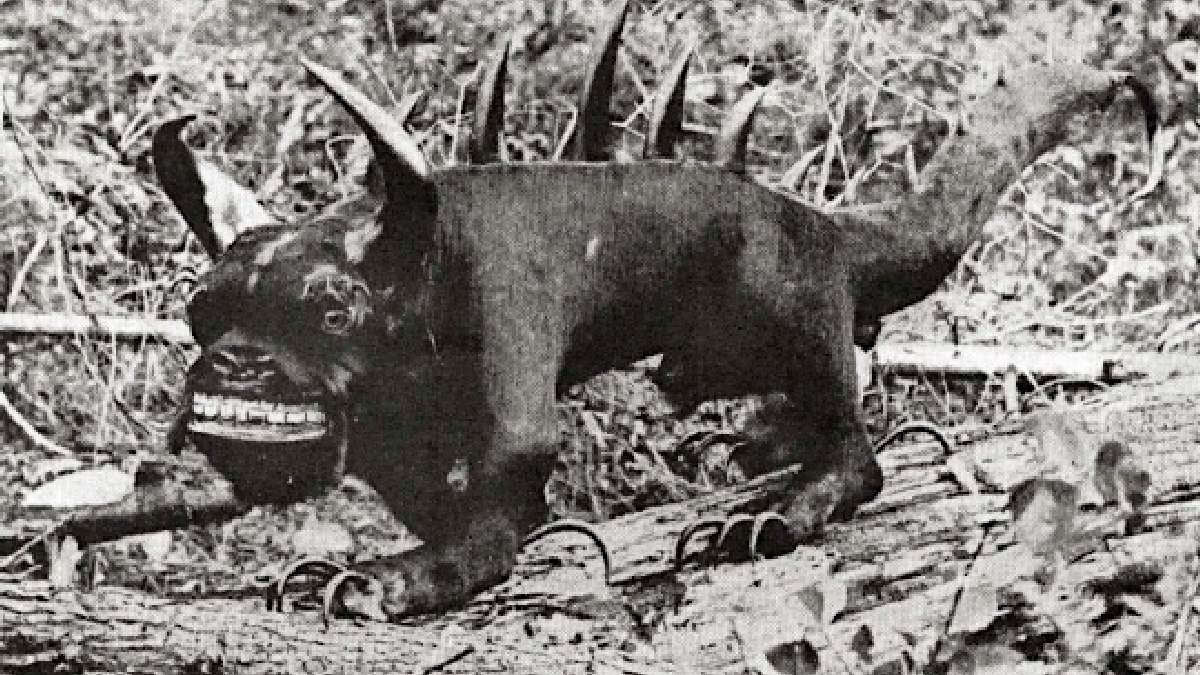
What is the Hodag?
If you’ve never heard of the Hodag, you’re not alone.
But in northern Wisconsin, especially around Rhinelander, it’s hard to miss. The creature shows up everywhere. Statues, signs, school mascots, local businesses. It’s part of the identity.
What makes it interesting isn’t just the green fur and horns. It’s about the story of how the hodag came to exist in the first place.
The Hodag is Unlike Anything You’ve Ever Heard of
The Hodag is usually described as a large, reptile-like creature with horns, glowing eyes, and a row of spines running down its back. Most versions give it sharp claws, thick green fur, and a low, heavy body, something between a dinosaur and a mythical beast.
It’s not based on any real animal. There’s no fossil, no scientific record, nothing that ties it to anything that actually existed. The design feels exaggerated on purpose. Almost theatrical.
And that’s because it was.
The Origin of the Hodag
The Hodag was first “discovered” in the late 1800s by a man named Eugene Shepard.
At the time, Rhinelander was a growing logging town, and stories about strange creatures weren’t unusual. Shepard took that idea further. He claimed he had tracked down a dangerous beast deep in the woods, something that had been terrorizing the area.
According to the story, the creature was so tough it had to be killed with explosives.
A few years later, Shepard introduced what he said was a captured Hodag, showing it off at local events and even charging people to see it. The creature was a clear fake, built from wood, hides, and horns, but the story had already taken hold.
For a while, people believed it. And even after they didn’t, the legend stuck.
How a Hoax Became Rhinelander’s Symbol
Most hoaxes disappear once they’re exposed. The Hodag did the opposite.
In Rhinelander, it’s a point of pride. There’s an annual Hodag Country Festival, one of the biggest events in the area, along with statues and references throughout the city.
The most recognizable is the giant Hodag statue outside the Chamber of Commerce. It’s oversized, bright green, and impossible to miss. It’s also one of the most photographed spots in town, drawing thousands of visitors every year who stop to see it and grab a picture.
It’s not trying to be believable anymore.
That’s not the point.
A Legendary Addition to Wisconsin’s Identity
The Hodag didn’t start as something real, but it became something that stuck.
It’s part of Wisconsin’s identity now. Not because it’s historical in the traditional sense, but because people decided it was worth keeping around. And in a state full of traditions that have been passed down over time, that might be what makes it fit the most.
Did you learn something new about the Hodag? Comment below or share on social media – we would love to hear your thoughts!